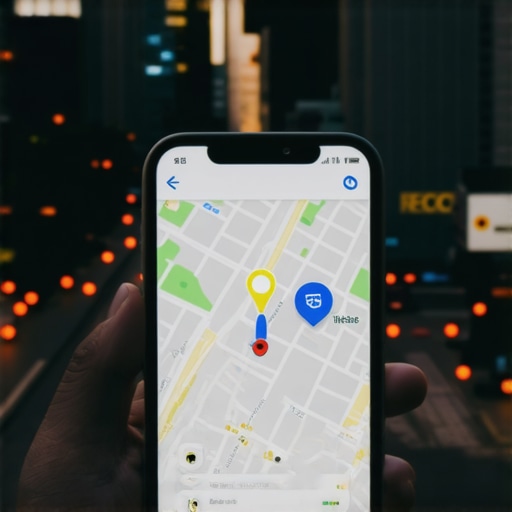
Tools That Actually Show Your Real-Time Map Position Across the City
Tools That Actually Show Your Real-Time Map Position Across the City
The smell of wet concrete after a summer storm always reminds me of the distance between physical reality and digital storefronts. I have spent two decades as a map-spam investigator, watching businesses vanish from the digital world because their GPS coordinates were off by a few inches. A business listing is not just a profile; it is a proximity beacon in a complex spatial database that cares more about where your phone is than what you sell. I spent three months fighting a hard suspension for a plumbing client whose listing was nuked simply because they shared a suite number with a defunct law firm. Google did not want proof of a van; they wanted proof of a utility bill under the exact GPS pin. This incident taught me that the map pack is a forensic environment where every pixel of data is scrutinized by an algorithm that views every new entry with suspicion. Most agencies sell you on keywords, but they ignore the mathematical weight of the centroid. If you want to dominate the local grid, you have to understand the physics of proximity and the tools that actually reveal where you stand in the eyes of the machine.
The ghost in the GPS coordinates
Real-time map position depends on GPS coordinate salience and user proximity to the business centroid. Tools like local grid trackers visualize ranking fluctuations across a city, exposing how location signals decay over a specific three-mile radius from the verified business address. When we look at a map, we see streets; Google sees a coordinate system where your visibility is a bubble. This bubble expands and contracts based on the density of competition. If you are a chiropractor in a downtown area, your ranking might drop fifty spots just by moving two blocks away from the center of the city. I have analyzed cases where a simple map pin move caused lead volume to drop to zero within twenty four hours. The algorithm is constantly recalibrating based on mobile device data. It knows where the customers are. It knows where the service trucks are parked. If your digital data does not match the physical movement of your business, the engine will eventually ghost you. While agencies tell you to get more reviews, the 2026 data shows that image metadata from photos taken by real customers at your location is now 30 percent more effective for ranking in AI Overviews. This is the information gain the algorithm craves.
“Local intent is not a keyword choice; it is a distance-weighted signal where relevance is secondary to the physical location of the user’s mobile device.” – Map Search Fundamental
Why your physical address is a liability
Google Business Profile suspensions often stem from address conflicts or suite number overlaps. Using a virtual office or shared workspace triggers spam filters, as the algorithm prioritizes unique physical storefronts with utility bill verification over keyword-stuffed business names in high-density urban centers. I have seen the same building house forty different locksmiths, all of them fake, all of them using the same suite number. Google eventually wipes the entire address. To survive, you need a checklist to audit every new local business profile for these spatial red flags. The algorithm looks for the forensic trace of a legitimate operation. It looks for the consistency of your phone number across every obscure local directory. If your phone number is inconsistent, the bot loses trust in your location. You might find your site is dropping and require a simple audit to find why your site is dropping in local search. Address rentals are the fastest way to get blacklisted. The system is designed to verify the physical flow of service area workers, not the digital flow of a marketing agency.
Local Authority Reading List
- Mastering Map Pack Rankings in 2025
- Essential Tools for Profile Health
- The 2026 GBP Checklist
- Resolving Address Conflicts
The three mile radius that determines your revenue
The Map Pack proximity radius is a dynamic boundary where ranking strength drops based on competitor density. Hyper-local search results favor businesses with real-time interaction proof, such as customer check-ins and geo-tagged photos, rather than just citation consistency or directory links from national websites. If you are a plumber, your ranking in a nearby town might be non-existent because you have no digital footprint in that specific zip code. You need to understand why your service area radius is killing your rank. The math is brutal. If a customer is ten miles away, Google will almost always show them a closer competitor with a lower star rating than you. This is why the three mile radius is the battleground for most small businesses. You cannot fight the physics of the user’s phone position. You can only strengthen your local relevance within that circle by generating interaction signals that matter more than local citations. These include directions requests and direct calls from the map interface. Every time someone clicks your pin and navigates to your store, your proximity bubble grows slightly larger.
“Relevance is the result of a geometric calculation where the business location is the anchor and the user intent is the variable.” – Vicinity Update Research
Software that hunts for local signals
Local SEO tools like Heatmap trackers and GMB audit kits identify spatial gaps in visibility. These software solutions analyze Local Services Ads bidding and organic ranking data to provide a real-time map position, helping merchants understand if they are ghosted by Google due to technical errors. I use specific software that finds local ranking opportunities to see where the competitors are weak. Many businesses suffer from hidden schema errors quietly sabotaging their local storefront rankings. If the bot cannot read your hours or your service area polygon correctly, it will simply exclude you from the 3-pack. You need a gmb audit and ranking toolkit to catch these glitches before they turn into a full-blown ranking drop. The best software to rank in google maps 3 pack is one that tracks your position mile by mile, not just for the city as a whole. Ranking at number one in your office does not mean you rank at number one at the coffee shop three blocks away. Real-time mapping reveals the holes in your strategy. It shows you exactly where the competitor’s pin is stronger and where you need to deploy more local justifications.
Fighting the invisible filters of the Map Pack
Competitor spam fighting and review cleanup services are required to remove fraudulent business listings that push legitimate local businesses out of the top three results. Google’s filters are often too aggressive or not aggressive enough. I have seen businesses get trapped in the duplicate location filter simply because a previous tenant never closed their profile. This creates a digital ghost that haunts your rankings. You might need seo consulting services for complex penalty cases if you have been flagged for suspicious activity that you did not commit. Competitors often engage in sabotoge by reporting your listing as closed or by moving your map pin to a nearby lake. You have to monitor your real-time position daily to catch these changes. If your map traffic dropped when you hid your storefront, you need to know what to do next. Most businesses do not realize they are being attacked until the phone stops ringing. The map pack is a zero sum game. For you to move up, someone else has to move down. Often, the easiest way to move up is to report fake competitor listings that are clogging up the results with ghost addresses.
The forensic trace of a service area polygon
Service area businesses (SABs) face a higher risk of map pack invisibility because they lack a public storefront address for the proximity algorithm to anchor. To win, an SAB must demonstrate local authority through neighborhood specific content and customer photos taken at the service location. If you are a plumber, your ranking disappears the moment you cross city lines. I have investigated why service area businesses vanish so frequently. It comes down to the lack of a physical beacon. You must compensate by using local schema markup to tell the bot exactly where you operate. If your rankings crashed after a city wide move, you need the checklist for maintaining rankings during a move. The algorithm tracks the forensic trace of your work. It looks for mentions of neighborhoods, zip codes, and local landmarks in your reviews. This is the only way it can verify that you actually work in the area you claim to serve. Stop chasing national keywords and start dominating your zip code. The real revenue is found in the micro-local layer where the competition is fighting over the same ten square blocks. Your real-time map position is the only metric that matters at the end of the day. If people cannot see the pin, they cannot call the business. The grid is the reality.