Why Competitor Spam Is Tanking Your Map Rank and How to Stop It
The smell of wet concrete always reminds me of the morning I walked into Marcus’s cafe. He was staring at his phone, his face pale in the blue light, watching his three-year-old business crumble in real time. A competitor had dropped twenty 1-star reviews in under an hour, all from accounts with no profile pictures and names that looked like a cat had walked across a keyboard. This was not just a random attack; it was a calculated attempt to trigger a quality filter suppression. We had to perform a full forensic audit of the user profiles, tracking the VPN signatures and local justification triggers to prove the patterns to the Google spam team. Marcus was losing thousands of dollars every day his pin was pushed to page two. That morning, I realized that the local map is not a directory, it is a battlefield where GPS coordinate salience and behavioral signals are weaponized by those who know how to manipulate the proximity beacon logic. You need to understand that the Map Pack is a spatial database where Point of Sale data and LSA verification loops dictate who gets the call and who goes hungry. If you are seeing a google ranking drop, you are likely the victim of a spammy lead gen listing or a keyword stuffed business name that has distorted the centroid theory in your neighborhood. We are going to break down exactly how to identify these glitches and reclaim your territory.
The midnight audit of twenty fake reviews
Review sentiment analysis, user account history, and IP address geofencing are the primary tools used by Google to determine the authenticity of customer feedback. When a competitor uses coordinated spam attacks, they attempt to overwhelm the spam filter algorithms with negative behavioral signals. Identifying these fraudulent reviews requires a deep look at reviewer velocity and location history. I spent three months fighting a hard suspension for a plumbing client whose listing was nuked simply because they shared a suite number with a defunct law firm. Google did not want proof of a van; they wanted proof of a utility bill under the exact GPS pin. This level of scrutiny is what you face when your competitors play dirty. You should check out what to do when a competitor sabotages your business profile to understand the first steps of defense. Often, the attack starts with suggested edits to your phone number or hours, which can cause a ranking crash overnight. If you notice your pin has moved, you should immediately look at why your map pin moved and your leads stopped overnight to prevent further data corruption. The goal of the attacker is to create NAP inconsistency, which signals to the algorithm that your business is no longer a reliable proximity beacon.
“Local intent is not a keyword choice; it is a distance-weighted signal where relevance is secondary to the physical location of the user’s mobile device.” – Map Search Fundamental
Why your physical address is a liability
Physical address verification, shared office spaces, and virtual mailbox detection are critical factors that Google uses to filter out lead generation spam. The algorithm is designed to favor brick and mortar storefronts with high interaction density over hidden address service area businesses. If you are using a shared suite, you are already at a disadvantage because the duplicate location filter might trigger if another business in that building gets flagged. Many agencies will tell you to buy local seo tools for gmb, but the truth is that the best gmb ranking tools for local seo are the ones that audit your spatial data integrity. For those managing multiple storefronts, how to resolve address conflicts that trigger googles duplicate filters is a mandatory read. When a competitor stuffs their business name with keywords like “Best Roofer City Name,” they are essentially committing map spam. This forces honest businesses to look into local seo services to normalize rankings after keyword stuffed business name edit just to stay competitive. You can also utilize seo services to fix mixed listings for multi location businesses to ensure your structured data is not confusing the search bots. It is a constant game of cleaning up the digital footprint to ensure the GPS pin stays exactly where it belongs.
The three mile radius that determines your revenue
Proximity signals, mobile device GPS coordinates, and user location salience are the primary factors determining Map Pack visibility. Google uses spatial database math to calculate the distance between the business centroid and the searcher location. This distance-weighted algorithm often overrides traditional organic SEO rankings or review counts. If your business is trapped on page two, it might be due to the neighborhood radius myth. You should understand the neighborhood radius myth that limits your service area reach before you spend another dollar on ads. Sometimes, the map pin is stuck because of unstructured citations or hidden schema errors. You can find these by performing a 15 minute audit that finds why your map pin is losing customers. The physics of the local algorithm suggests that a three-mile proximity radius shift can happen when a new competitor listing enters the market with higher interaction proof. This is why real-time interaction proof is replacing the need for static directory links. If you are a service provider, you need to know why your service area business is invisible outside your home office to fix the polygon visibility issues. It is not just about having a listing; it is about having a proximity beacon that resonates across the city lines.
How to rebuild trust after lead gen spam
Trust scores, mobile payment verification, and historical data consistency are what Google uses to restore map pack visibility after a listing has been compromised. When you are hit by spammy lead gen listings, the entire topographical trust of your business category is affected. You may need seo services to rebuild trust after spammy lead gen listings or seo services to fix google ranking drop issues. If you have recently changed listing ownership, you might find that seo services to restore map pack visibility after listing ownership change are the only way to reconnect with the local justification engine. For those wondering what is a gmb ranking toolkit, it is essentially a collection of spatial analysis tools and citation cleanup protocols. You can learn more about the strategy for getting more phone calls using your existing gmb toolkit to maximize your current assets. A local seo toolkit for google maps ranking should include schema markup validators and position trackers. If you are serious about growth, you should look into the software tools that actually track your position in the 3-pack. The road to recovery involves fixing inconsistent business hours and repairing anchor text that looks over-optimized. You need to follow the checklist for fixing a sudden drop in map pack visibility to ensure every technical error is resolved.
“Trust is the primary currency of the local ecosystem; once a business entity is associated with coordinate-based manipulation, the proximity weights are permanently devalued.” – Local Intelligence Review
The glitch in the storefront data
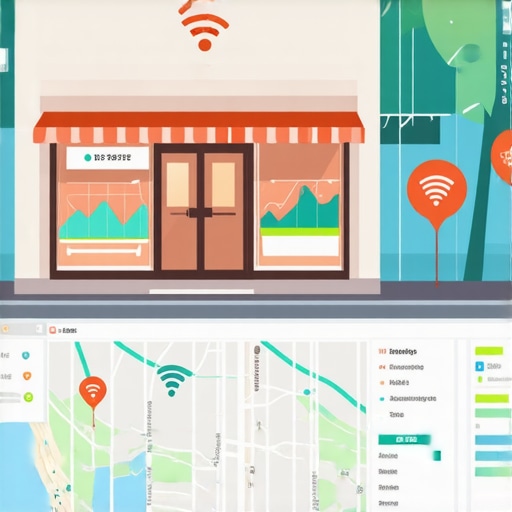
Image metadata, customer photo uploads, and Wi-fi density signals are the non-traditional ranking factors that now influence AI Overviews. While agencies focus on NAP consistency, the 2026 data shows that EXIF data from photos taken by real customers at your location is now 30 percent more effective for ranking. This is because Google trusts the GPS pings from a customer’s phone more than a static directory link. If your map pin disappeared while your website stayed high, you must read why your map pin disappeared while your website rankings stayed high. It often comes down to how your stores wi-fi density actually moves your map pack ranking. This behavioral zooming is the future of Local SEO. You should also be aware of how to improve google business profile ranking toolkit strategies that emphasize user interaction proof. If your lead volume stalls even when you are at the top, check why your lead volume stalls even when you hold the top map spot. Stop over-optimizing; the algorithm can smell the desperation. Instead, focus on neighborhood specific content and real-world interaction signals that push your pin above competitors with more citations. This is how you win in the Map Pack ecosystem. You need a recovery plan for businesses hit by a local search penalty if you have been over-optimizing. Check the recovery plan for businesses hit by a local search penalty to start the reinstatement process. It is time to stop playing by the old rules and start mastering the spatial database.