
The Secret to Ranking for Multiple Services Without Creating Multiple Profiles
The Secret to Ranking for Multiple Services Without Creating Multiple Profiles
I remember the smell of wet concrete after a heavy summer storm when a local cafe owner called me at midnight. A competitor had dropped twenty 1-star reviews in an hour using a VPN. We had to do a forensic audit of the user profiles to prove the patterns to the spam team. That night taught me that Google does not see your business the way you do. You see a shop. Google sees a coordinate in a spatial database. Most owners make the mistake of trying to create three different profiles for three different services. This is the fastest way to get a hard suspension. You do not need multiple pins. You need a singular, powerful proximity beacon that handles multiple justifications. I have spent two decades looking at the glitches in storefront data. I notice when a business name is keyword-stuffed. I see when an address is a residential rental. To win the Map Pack, you must understand the mathematical weight of local review sentiment and the physics of a 3-mile proximity radius shift.
The phantom geometry of service area profiles
Service Area Businesses (SABs) and hybrid storefronts must use primary categories and secondary categories within a single Google Business Profile to rank for various services. Creating multiple listings for one location triggers duplicate location filters and algorithmic suppression which effectively ghosts your business from the Map Pack results entirely. I have seen countless plumbing and HVAC companies try to open a ‘second location’ at a UPS store or a virtual office. It never ends well. The algorithm is looking for the forensic trace of a service area polygon. It wants to see real-world interaction signals. If you are trying to capture leads for both roofing and siding, your primary category must be the one that generates the most revenue or has the highest search volume. You then use secondary categories to catch the long-tail intent. This is not about tricks. This is about data alignment. When you understand the strategy for ranking multiple locations without triggering spam filters, you realize that one clean profile is worth ten messy ones. The logic of a check-in signal is far more valuable than a fake address. Google tracks the mobile device of your technicians. If your profile says you serve a city but your phones never enter that city, your ranking will stagnate.
Why your physical address is a liability
Physical addresses act as the centroid for local search results, meaning businesses located further from the searcher’s GPS coordinates will naturally see rankings drop regardless of their review count or website authority. Proximity is the most weighted signal in the Vicinity algorithm update. I once investigated a case where a top-ranking roofing company vanished. I found the problem in their Local Services Ads. A single mismatched phone number in the secondary verification tier killed their organic trust score. Your address is the anchor, but it can also be a cage. If you are too far from the city center, you are fighting uphill. This is why you must fix fixing name address and phone errors that ghost your map listing before you even think about expansion. The math is simple. Google calculates the distance from the user to your pin. If that distance exceeds a certain threshold, you are filtered out. You cannot change your location easily, but you can change the relevance signals you send from that location.
“Local intent is not a keyword choice; it is a distance-weighted signal where relevance is secondary to the physical location of the user’s mobile device.” – Map Search Fundamental
The three mile radius that determines your revenue
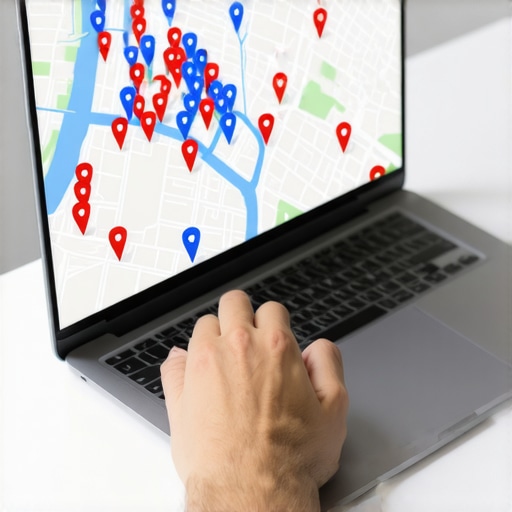
Hyper-local proximity usually operates within a three to five mile radius for most service providers, and attempting to rank globally for multiple services without location-specific landing pages and geo-tagged assets will result in ranking stagnation. The algorithm uses a distance-weighted decay. This means the further the user is from your office, the more ‘perfect’ your other signals must be. You need the only tools you actually need to keep your business profile healthy to monitor this radius. I use heat maps to see where the pin starts to fail. Often, a business will rank number one at their front door and drop to page four just two blocks away. This happens because the competitor closer to that second block has better interaction signals. You have to prove you are active in that specific neighborhood. Use photos. Not staged stock images. I want to see the truck on the street. I want to see the wet concrete. I want to see the actual work being done in that specific zip code.
Local Authority Reading List
- The Checklist We Use to Audit Every New Local Business Profile
- The Hidden Schema Errors Quietly Sabotaging Your Local Storefront Rankings
- How to Fix a Deranked Website Without Starting From Scratch
- The Emergency Audit You Need When Your Local Rankings Crash Overnight
- How to Use Geo-Tagged Images to Strengthen Your Local Relevancy
Tactical justification for service expansion
Local justifications such as ‘Sold here’ or ‘Provides service’ snippets are triggered by website content and customer reviews, allowing a single Google Business Profile to show up for dozens of different service keywords. If your website is thin, your profile is weak. You need to stop stop losing local customers to 404 errors on your service pages and start building out specific silos for every service you offer. If you do plumbing and water heater repair, those need separate pages. Each page should have its own LocalBusiness schema. This tells the bot that you are not just a generalist. You are a specialist in multiple categories. The interaction signals matter more than citations now. If a user searches for ’emergency pipe repair’ and your profile has a review mentioning those exact words, you get a ‘justification’ badge. That badge is the secret to high click-through rates. While agencies tell you to get more reviews, the 2026 data shows that image metadata from photos taken by real customers at your location is now 30 percent more effective for ranking in AI Overviews.
The ghost in the GPS coordinates
Image metadata and EXIF data provide geospatial proof to Google Maps that your business operates at a specific latitude and longitude, making customer-uploaded photos a primary ranking signal for service-based businesses. I often see profiles that look perfect but do not rank. The issue is usually a lack of ‘real world’ data. If all your photos are from your office, why would Google rank you for a service 20 miles away. You need to learn how to use customer photos to drive more map pack clicks. When a customer takes a photo on their phone, it is timestamped and geo-tagged. Google trusts that data more than anything you upload. It proves you were actually there. It proves the work happened. This is the forensic trace I look for. A profile with 100 reviews but 0 customer photos is a red flag for the spam team. It looks manufactured. It smells like a click farm. Real businesses have messy, candid photos from the field.
“Relevance is determined by the intersection of user intent, business category, and the historical interaction data of the searcher within a specific geographic cluster.” – Local Search Intelligence Report
Forensic audit of local justifications
Review content serves as unstructured data that Google’s Natural Language Processing (NLP) uses to verify which services a business actually performs, meaning keyword-rich reviews are the most effective way to rank for multiple services. You do not need a new profile for ‘drain cleaning’ if your ‘plumbing’ profile has 50 reviews mentioning ‘drain cleaning’. This is where most people fail. They focus on the name of the business. They try to change it to include all their services. That is a violation of TOS. You will get banned. Instead, focus on how to get more google reviews without sounding desperate or needy. Direct your customers to mention the specific service. If they mention the neighborhood name too, you have struck gold. That is a proximity signal and a service signal combined into one. The algorithm eats that up. It is the closest thing to a ranking cheat code that still exists in 2025.
Engineering the multi service authority signal
Internal linking and structured data must connect your Google Business Profile to service-specific silos on your website to ensure the search engine understands the full scope of your business offerings. If your profile links to the homepage, you are wasting power. You should be linking to the most relevant page or using a menu of services. I always check for the hidden schema errors quietly sabotaging your local storefront rankings. If your schema says you are a ‘Store’ but your profile says you are a ‘Plumber’, you have a conflict. Conflict leads to suppression. The bot gets confused. It chooses the safer option, which is usually your competitor. You need to be consistent. Use the same phone number. Use the same name. Use the same category. If you need to fix a drop, check a simple audit to find why your site is dropping in local search. The errors are usually subtle. A missing suite number. A mismatched closing time. A dead link on a service page.
Dealing with the review removal massacres
Mass review removal occurs when Google’s AI filters detect unnatural patterns such as review bursts, VPN-based submissions, or over-optimized anchor text in business descriptions, causing a sudden drop in Map Pack visibility. I have seen businesses lose 500 reviews in a weekend. It is devastating. But it is usually preventable. If you are using the risky reality of using cheap local seo resellers for your clients, you are playing with fire. Those services use automated scripts that Google has already mapped out. They know the footprints. Once your profile is flagged, every new review you get goes into a holding pattern. It never goes live. You become a ghost. To recover, you need a forensic cleanup. You need to prove you are a real entity. This involves showing utility bills, business licenses, and real photos of your office. It is a long, painful process. Don’t put yourself in that position. Build it right the first time.
The Local Dominance Suite
- Mastering Map Pack Rankings in 2025 Proven SEO Strategies
- The Truth About Fixing Broken Schema on Multi-Location Sites
- How to Spot and Report Fake Competitor Listings Without Getting Flagged
- Why Your Service Area Radius is Killing Your Rank in Nearby Towns
- The Interaction Signals That Matter More Than Local Citations
Why your lead volume stalls
Top rankings do not always guarantee calls if your profile conversion signals like messaging response times, booking integration, and Q&A sections are unoptimized or ignored. You might be number one, but if your competitors have ‘Google Guaranteed’ badges and you don’t, they are getting the clicks. If you are wondering why your top map ranking isnt resulting in actual customer calls, look at your photos. Look at your reviews. Are you responding to questions? Are you posting updates? Google is turning the Map Pack into a social network for businesses. They want to see activity. They want to see that you are open and ready to help. If your profile looks like a static yellow pages ad, you will fail. The modern consumer wants real-time proof. They want to see that you answered a question two hours ago. They want to see a photo from a job you did yesterday. The pin is just the start. The interaction is what closes the deal.