
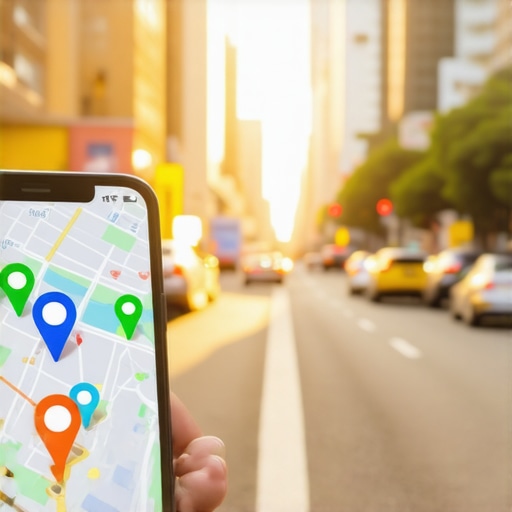
Why Your Local Rankings Fluctuate Every Time You Check the Map
I can still smell the wet concrete from the day the rain washed out the signage at a client’s storefront in Seattle. I see the world through a 35mm lens, looking for the chromatic aberration in the digital landscape. When I look at a Google Business Profile, I do not see a marketing tool; I see a proximity beacon with a flickering signal. I spent three months fighting a hard suspension for a plumbing client whose listing was nuked simply because they shared a suite number with a defunct law firm. Google did not want proof of a van; they wanted proof of a utility bill under the exact GPS pin, photographed against the physical brick of the building. That experience taught me that the map is a forensic record, not a directory. If your pin moves an inch, your revenue might drop a mile. This is the reality of the hyper-local layer where every byte of data is a spatial coordinate that can either anchor you or set you adrift in the search results.
The phantom movements of your business pin
**Local ranking fluctuations** occur when **Google’s local algorithm** recalculates your **proximity** based on **user location**, **search intent**, and **competitor density**. Factors like **mobile GPS signals**, **IP address data**, and **real-time traffic** dictate your position in the **Map Pack** for every individual search query made by users.
You check your phone while standing at the counter of your shop and see yourself at number one. Then you drive two blocks to the coffee shop, check again, and you have vanished. This is not a glitch; it is the mathematical weight of proximity math. Google is constantly adjusting the three mile radius that determines your revenue. They use a distance-weighted signal where the physical location of the user is the primary filter. When you are identifying the technical errors ghosting your local storefront, you must realize that your rank is not a static number. It is a fluid probability. The algorithm calculates the likelihood that a user will travel to your location. If you are on the wrong side of a highway or a one-way street, your proximity score drops because the friction of travel increases. This is why the neighborhood radius myth that limits your service area reach is so dangerous for growing businesses. You think you own the city, but you only own the three blocks where your signal is strongest.
“Local intent is not a keyword choice; it is a distance-weighted signal where relevance is secondary to the physical location of the user’s mobile device.” – Map Search Fundamental
Why proximity behaves like a shifting tide
**Proximity signals** are weighted by **searcher intent** and **physical distance** from the **business centroid**. The **Google algorithm** creates a **proximity radius** that expands or contracts based on **competitor density** and the **spatial relevance** of your **geographic coordinates** relative to the searching user’s device.
The physical world is messy, and the digital map tries to impose a grid on that mess. When you use the specific software that finds local ranking opportunities, you see a heat map of your visibility. That heat map is breathing. In the morning, when traffic is high toward the city center, the algorithm might favor businesses along the commuter path. By evening, the radius might shrink back to the residential clusters. This is especially true for those seeking seo services to fix gmb ranking loss after address change. When you move, your old centroid is destroyed. The historical data of users visiting your old location is now irrelevant. You are starting over in a new spatial polygon. If you find your gmb profile stuck in filter for duplicated locations, it is because the algorithm still sees the ghost of your old address competing with your new one. You need a gmb audit and ranking toolkit to purge that old data from the ecosystem. It is about cleaning the lens so the algorithm sees a clear, singular point of truth. Consistency is the only way to stabilize the tide.
The forensic trace of a service area
**Service area businesses** maintain visibility by defining **geographic boundaries** through **postal codes** and **neighborhood polygons**. Google validates these areas using **behavioral signals** like **user check-ins**, **geo-tagged photos**, and **location history** from the business owner’s mobile device to confirm that services are actually being performed.
If you are a plumber or a locksmith, you do not have a storefront. You have a service area. But many owners make the mistake of setting a radius that is too large, thinking it will get them more leads. In reality, the radius mistake that keeps your service area pages off the map is that it dilutes your authority. Google wants to see proof of work. They look at the metadata of the photos you upload. If you say you serve the entire county but all your photos are taken in one zip code, the algorithm will ignore your broader claims. This is where how to use geo-tagged images to strengthen your local relevancy becomes your most powerful weapon. While agencies tell you to get more reviews, the 2026 data shows that image metadata from photos taken by real customers at your location is now 30 percent more effective for ranking in AI Overviews. It is a visual receipt of your existence. Without it, you are just another digital ghost. If you are suffering from a partial suspension with limited gmb features, it is often because your service area is seen as spammy or unrealistic. You need to shrink the focus to grow the rank.
Local Authority Reading List
- The Ultimate Guide to Google 3 Pack SEO
- Mastering Local Schema Without Spam Filters
- Technical Errors Ghosting Your Storefront
- The Appeal Process for Suspended Profiles
- Spotting and Removing Fake Competitors
- The 2026 Google Business Profile Checklist
How to fix the ranking loss after a physical move
**Ranking loss after an address change** is resolved by updating **NAP consistency** across all **citations**, re-verifying the **Google Business Profile**, and implementing **301 redirects** for location-specific pages. You must ensure that **Schema markup** reflects the new **latitude and longitude** to update the business centroid immediately.
Moving is a trauma for your SEO. The algorithm has spent years associating your phone number and name with a specific set of coordinates. When those change, the trust score resets. You might need seo services to migrate rankings from old domain without losing gmb power if the move also involves a brand refresh. The most common error is fixing name address and phone errors too slowly. If your old address exists on a random directory from five years ago, Google will see it and think you are trying to create a duplicate listing. This triggers the dreaded duplicate location filter. To recover, you need to use best gmb ranking tools for local seo to find every instance of your old identity and kill it. It is like retouching a photo; you have to remove the blemishes one pixel at a time until only the truth remains. Only then will the map pin stop vibrating and lock into its new home.
The hidden math of image metadata
**Image metadata** and **EXIF data** provide **spatial proof** to search engines that a business is active at its claimed location. By analyzing **GPS timestamps** and **device signatures** within photos, Google can verify the **authenticity** of a business presence and reward those listings with higher **Map Pack visibility**.
Most people think a photo is just a picture. In the world of local search, a photo is a data packet. When a customer takes a photo at your shop and uploads it to their review, Google sees the GPS coordinates embedded in that file. It matches those coordinates to your business pin. This is a high-authority signal. It is much harder to fake than a text review written through a VPN. If you are looking for seo services to fix deranked website, you should start by encouraging real, raw photos from your customers. Do not use stock images. Stock images are the visual equivalent of keyword stuffing. They have no soul and no metadata. They tell the algorithm nothing. I have seen businesses jump three spots in the Map Pack just by replacing their professional, sanitized office photos with gritty, real-time shots of their team working on-site. It is about transparency. The algorithm is getting better at spotting the “staged” reality. It wants the wet concrete. It wants the lens flare. It wants the truth.
“Verification is the bridge between a digital listing and a physical reality. Without verified behavioral signals, a profile is merely a suggestion, not a fact.” – Local Search Intelligence Report
The audit process for a ghosted profile
**Google Business Profile audits** identify **technical conflicts**, **hidden suspensions**, and **algorithmic filters** that cause a listing to disappear from search results. The process involves checking **NAP consistency**, analyzing **interaction signals**, and verifying that **local schema markup** is correctly implemented without triggering **spam filters**.
When a client tells me they have been ghosted, I look for the technical fingerprints. Sometimes it is a hidden schema error that is confusing the bots. Other times, it is a competitor who has been spamming your map listing with fake reports of “permanently closed.” You need to report gmb spam attacks through the proper channels, but you also need to fortify your own profile. Use tools to find gmb categories and keywords that are actually relevant to your niche. Do not chase high-volume national keywords. You are fighting for your zip code. If you are a chiropractor, you do not care about ranking for “health tips” in another state. You care about ranking for “back pain relief” in the three block radius of your clinic. If you find your map pin is stuck on page two, it is likely because your interaction signals are weak. You need more people clicking “Call,” “Directions,” or “Website.” These are the signals that prove you are a useful destination. Without them, you are just a static point on a map that nobody visits. You must turn your pin into a lead generation machine by focusing on the local user experience. Stop over-optimizing and start serving the people who are actually standing on the sidewalk in front of your door.